Gemini opens your page as just “Google”, DeepSeek as Firefox
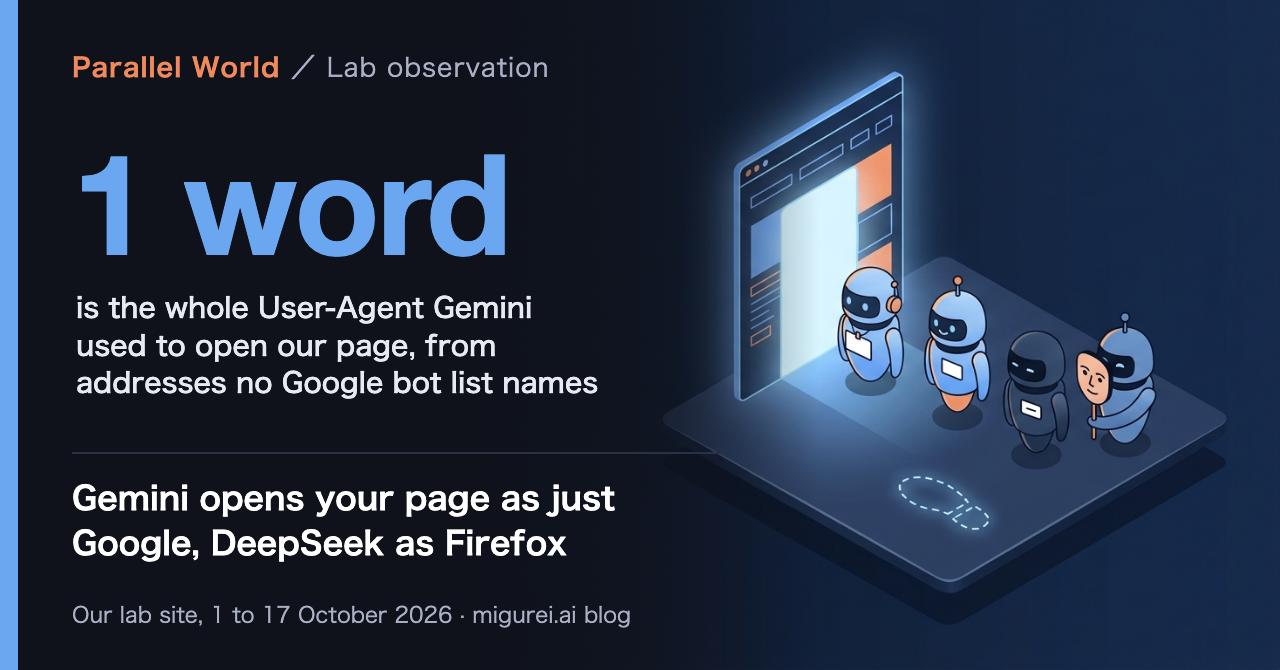
When we pasted our own test page into four AI apps, ChatGPT and Claude arrived under a bot name of their own. Gemini arrived with the single word "Google" as its User-Agent, from addresses no Google bot list names. DeepSeek arrived looking like Firefox on Linux. Perplexity sent no request at all.
The claim in full: Asked to open a page, ChatGPT and Claude arrived under their own bot names, Gemini as the single word "Google" from addresses no Google bot list names, DeepSeek as Firefox on Linux, and Perplexity sent no request (our lab site, 1 to 17 October 2026).
We pasted a link and read the log
Between 1 and 17 October 2026, our lab pasted pages of our research site into ChatGPT, Claude, Gemini, DeepSeek and Perplexity. Each pasted link carried a unique token, so a request in our server log could be matched to the app that opened it. This is the case where a user asks an app to read a page: not a crawl, a fetch on someone's behalf.
We expected each app to show a name we could look up. Two did.
- We paste a link with a unique token into the appOne token per question
- The app opens the page for the userA fetch on someone's behalf, not a crawl
- Our server logs User-Agent and IPEach request carries the token
- The token tells us which app it wasThen we compare name and address with what the vendor publishes
Source: our lab site's access log, 1 to 17 October 2026; Google's published address lists and user-triggered fetcher page, read 11 November 2026. The token proves which app was asked, not who runs the machine.
Four apps, four ways of arriving
What the log showed, 1 to 17 October 2026:
- ChatGPT: User-Agent containing
ChatGPT-User/1.0, 173 requests across 143 runs. - Claude:
Claude-User/1.0, 150 requests across 122 runs. - Gemini: a User-Agent that is only the word
Google, 155 requests across 153 runs, from six addresses in the 192.178.21.x range (plus one request from another address in Google's general range). - DeepSeek: an ordinary browser string,
Firefox/149.0on Linux, 445 requests across 149 runs. - Perplexity: no request in any run. In 7 runs with our page pasted, Perplexity said in 6 that it could not fetch the page.
"Google" is not on any Google list
We checked Gemini's six addresses against Google's published lists on 11 November 2026. All six sit inside Google's general address range (192.178.0.0/15). None sits in Google's lists of common crawlers, special crawlers, user-triggered fetchers (the fetchers that run when a person asks), the Google-specific user-triggered fetcher list, or user-triggered agents. Google's page on user-triggered fetchers names Google-Read-Aloud, Google-Agent, Google-GeminiNotebook and others; none of them is a User-Agent made of just "Google".
- ChatGPT
- User-Agent
- ChatGPT-User/1.0
- Requests (runs)
- 173 (143)
- Claude
- User-Agent
- Claude-User/1.0
- Requests (runs)
- 150 (122)
- Gemini
- User-Agent
- Google (the single word)
- Requests (runs)
- 155 (153)
- DeepSeek
- User-Agent
- Firefox/149.0 on Linux
- Requests (runs)
- 445 (149)
- Perplexity
- Requests
- 0
Source: requests carrying a test token on our lab site, 1 to 17 October 2026. Gemini: six addresses in 192.178.21.x, plus one request from another Google address. Perplexity: 7 runs, 6 answers said the page could not be fetched.
So Gemini's fetch is Google infrastructure with no name that Google lists for it. We cannot call it a Google bot by any official list; we only know the requests carried our Gemini test tokens. The last such request on our site was on 14 October 2026.
What it means for your logs
If you look for AI visits by bot name, you find ChatGPT and Claude, and miss Gemini and DeepSeek. A rule written on bot names, whether to allow or to block, does not reach a request that says "Google" or looks like a browser. "No AI bot in my log" may mean "no AI bot under a name I searched for".
What you can do
- Search your log for all four patterns over a week:
ChatGPT-User,Claude-User, a User-Agent that is exactlyGoogle, andFirefox/149.0on Linux, which you can tell from a visitor only by context, such as a page nobody links to. Note which pages they asked for. - Do not conclude from absence. A log without bot names does not show that AI apps never read your pages.
- Check what your robots.txt says to the named bots, and whether the server answers them, with the free check on
pw(our research site): https://pw.migurei.ai/en/free-scan . It does not identify Gemini's or DeepSeek's fetches; steps 1 and 2 do that.
What this does not show
- One site, one account per app, our lab's machine, our test pages, 1 to 17 October 2026. The User-Agent and the addresses can change at any time; we have not looked at them since 17 October, apart from the address check on 11 November.
- We do not know whether Gemini uses this User-Agent for every user, or only for the way our lab asks. On our site no request with the User-Agent "Google" came without one of our test tokens.
- We cannot prove the requests are Google's. We know the addresses are in Google's general range and that the requests carried our Gemini tokens.
- Not a count of how often AI visits real sites. Every request here was caused by our own test.
What would show more: the same check on a site with real visitors, and on a later date.
This post is written by Parallel World (migurei.ai) about measurements on our own lab site. The free check above is our own service.
The full numbers, with the dates and how we counted: User-Agents of AI apps fetching a pasted URL (https://pw.migurei.ai/en/research/ai-apps-user-agents-for-pasted-urls)
Sources
- https://developers.google.com/search/docs/crawling-indexing/google-user-triggered-fetchers
- https://www.gstatic.com/ipranges/goog.json
The measurements behind this are on Parallel World
What this does not prove
One lab site, one account per app, requests carrying our test tokens; User-Agents and addresses can change; the requests are tied to Google only by an address in its general range.