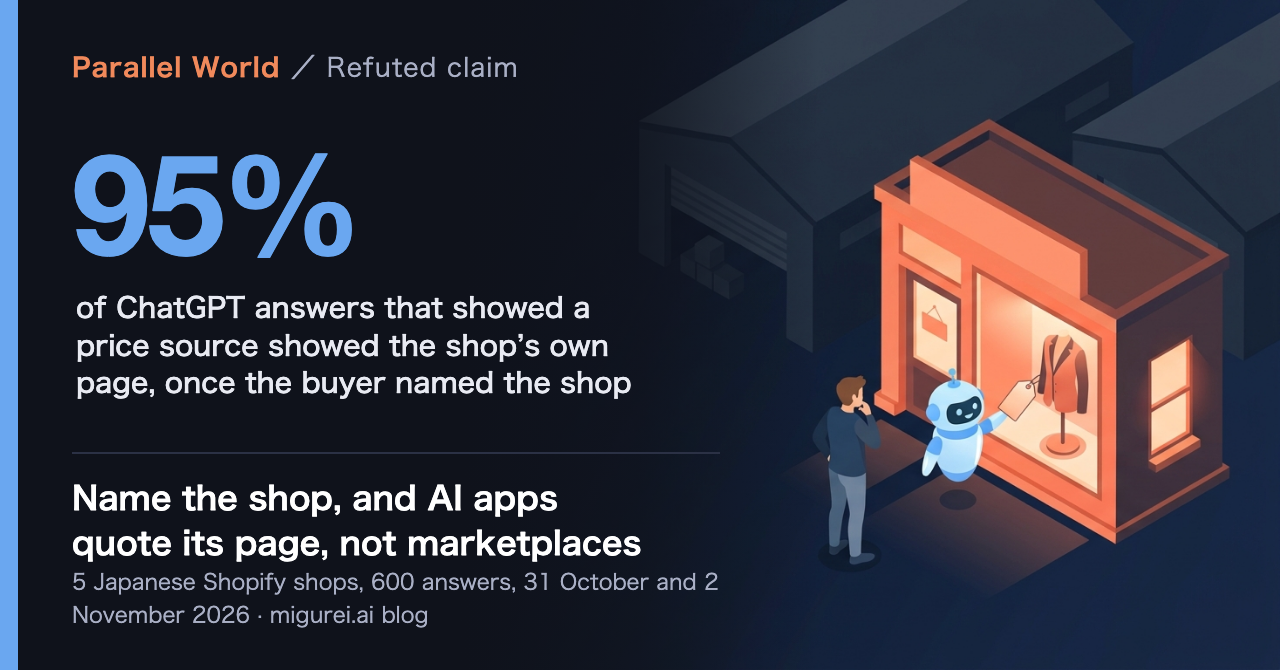
Name the shop, and AI apps quote its page, not marketplaces
Say you sell on your own shop site and on Rakuten too, and a customer names your shop and asks an AI app what an item costs. Almost every time, the app cites your shop's page, not the marketplace, so the price on your page, even an old crossed-out one, is the price the customer hears.
Where do AI apps get the price?
When a buyer names a shop and asks the price of an item, AI apps cite the shop's own page as the source, almost every time. Marketplaces barely appear. We expected the opposite.
- if it names the shop or pastes its linkSource: the shop's own pageNearly every answer that shows a source
- if it does not name the shopLeaned to marketplacesOnly recorded, not yet measured
Source: our lab, ChatGPT, Gemini, Claude and DeepSeek, free accounts from Japan, five Japanese Shopify fashion shops, 31 October and 2 November 2026; questions named the shop or pasted its link. The branch without the shop name was only recorded, not measured against a rule.
Many Japanese shops sell on their own site, on marketplaces such as Rakuten and Qoo10, and through price-comparison feeds such as Google Shopping and Kakaku. Marketplaces are big sites, so it is easy to think the AI apps take the price from there, and that a shop should fix its marketplace listings first.
How did we test it?
At the end of October and start of November 2026 we asked ChatGPT, Gemini, Claude and DeepSeek for the price of items from five Japanese fashion shops, from Japan. The main questions named the shop's address or pasted the product page link. Before asking, we wrote down what would prove our guess wrong. We do not name the shops.
- 29 Oct 2026What counts as a wrong guess is written down
- 31 Oct 2026Day 1: four apps, five shops
- 2 Nov 2026Day 2: the same questions again
- NextQuestions that do not name the shop, with conditions written first
Source: our lab, 2026. 600 answers in all: 480 to questions that named the shop, 120 to questions that did not.
The result: the shop page is the source
For ChatGPT, among answers that showed a price source, 95% showed the shop's own page.
The other three apps were the same. The lowest was Gemini, still close to 9 in 10.
Marketplaces and price feeds were almost absent: each at most twice per app per day. For an item the shop does not sell on any marketplace, no answer mentioned a marketplace.
The app reads your page, unclear parts included
Because the app cites your page, the price on your page is the price the buyer hears. On the first day, ChatGPT three times gave a struck-through old price as the selling price.
The apps do not read prices equally well, either. Gemini got it right almost every time. Claude gave no price at all in about one answer of every three.
- Gemini
- Right price
- 116 of 120
- Wrong price or item
- 4
- No price
- 0
- ChatGPT
- Right price
- 103 of 120
- Wrong price or item
- 9
- No price
- 8
- DeepSeek
- Right price
- 77 of 120
- Wrong price or item
- 26
- No price
- 17
- Claude
- Right price
- 75 of 120
- Wrong price or item
- 3
- No price
- 42
Source: our lab, ChatGPT, Gemini, Claude and DeepSeek, free accounts from Japan, five Japanese Shopify fashion shops, 31 October and 2 November 2026; questions named the shop or pasted its link. 120 graded answers per app over the two days. Graded by one model; a person has not re-read them yet.
What should you do?
- Keep the price on your own page clear and single. The current price in plain text, the old price marked as old.
- Do not rush to fix marketplace listings out of fear that AI apps quote them. For buyers who already know your name, your page is the source.
- Ask the apps a question without your shop name, such as "where can I buy [item], and for how much?", on a few different days, and note which sites are named.
- Check that AI bots can reach and read your shop with the free check on
pw(our research site): https://pw.migurei.ai/en/free-scan
- One clear price on your pageCurrent price in plain text, old price marked as old
- Do not start with marketplacesFor buyers who know your name, your page is the source
- Ask without your shop nameOn a few days; note which sites are named
- Check bot accessFree check on pw: can AI bots reach and read your shop?
Steps 1 to 3 need no tools; step 4 is our free check, which shows bot access and readability, not what the apps quote.
What we do not know yet
What about buyers who do not know your name yet? We also asked questions without the shop name, and they leaned towards marketplaces: on the second day, about 1 in 4 Gemini answers showed a marketplace and none showed a shop. That was only recorded, not measured against a rule. It is what we will measure next.
- Showed a marketplace4 answers26.7%
- Showed the shop00%
- Showed neither11 answers73.3%
Source: our lab, Gemini, 2 November 2026, 15 answers to questions that did not name the shop. Only recorded, not measured against a rule.
This post is written by Parallel World (migurei.ai) about measurements from our own lab. The free check above is our own service.
The full numbers, dates and how we counted: Price source of five Japanese Shopify shops: 600 answers (https://pw.migurei.ai/en/research/japanese-shopify-shops-price-source-600-answers)
Sources
This is an observation from our own lab; the raw data is not published here.
The measurements behind this are on Parallel World
What this does not prove
This holds only when the question names the shop or pastes its link; buyers who do not know your name may be sent through a marketplace.
Five fashion shops on Shopify, free accounts, two days: not all of Japanese e-commerce.
It shows which page an app cites, not that it read the price there.