Blocking GPTBot did not cost sites their name in ChatGPT
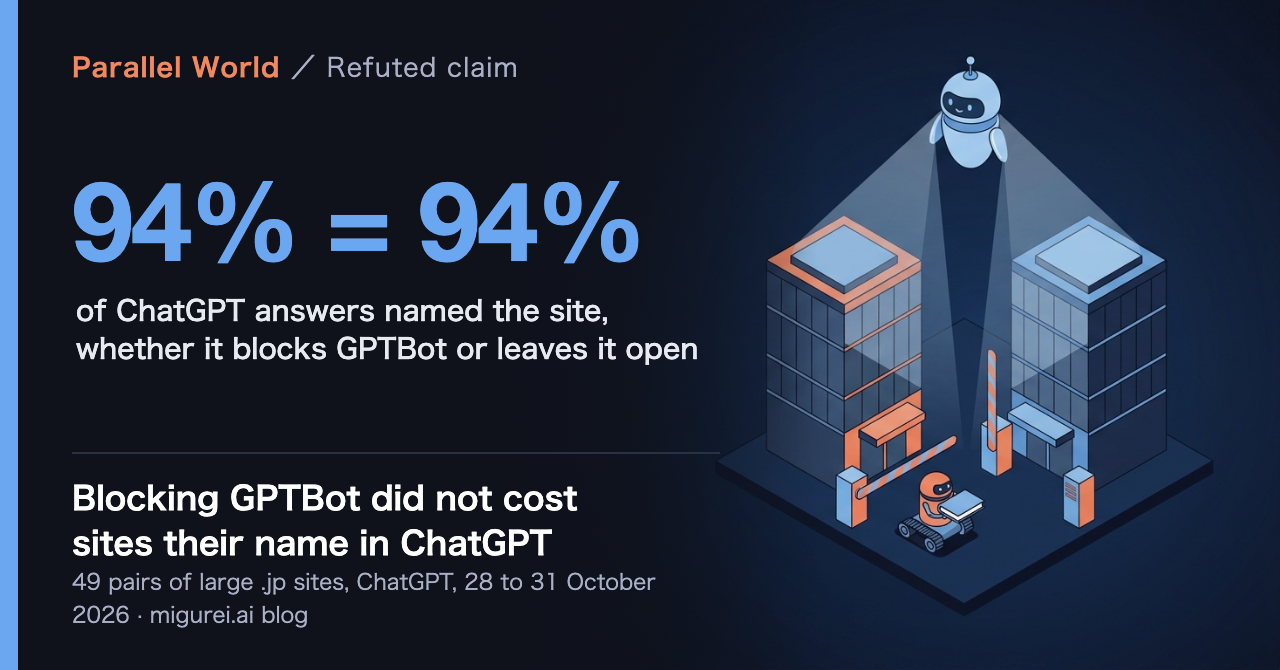
Say you block GPTBot, the bot OpenAI uses to train its AI, and then worry that customers asking ChatGPT will no longer see your company's name. Across pairs of large Japanese sites in the same industry, ChatGPT named the blocking sites just as often as the open ones, in more than 9 of 10 answers.
What did we ask ChatGPT?
At the end of October 2026 we asked ChatGPT ordinary Japanese questions, the kind a person asks when looking for a service in some industry. No question named a site. Then we checked whether ChatGPT mentioned the site we were watching. Half of those sites block GPTBot; the other half do not. Both halves were named almost exactly as often.
Why do people worry?
GPTBot is the bot OpenAI sends to read web pages for training its AI. Many sites block it in robots.txt (the public file that tells bots what they may read) because they do not want their text used as training data. But ChatGPT is OpenAI's too. So the worry is natural: if I block the training bot, will ChatGPT stop naming me when a customer asks?
How did we test it?
We matched 49 pairs of large Japanese sites. In each pair, one site blocks GPTBot and one does not, in the same industry and of a similar size. We asked ChatGPT about each site's industry, with a free account, from Japan. Before asking, we wrote down what would count as a gap.
- Pick a pairTwo large .jp sites, same industry, similar size: one blocks GPTBot, one does not
- Ask ChatGPTAn ordinary Japanese question about the industry, twice per site, no site name
- Check the answerIs the site named? Is there a link to it?
- CompareBlocking sites against their open partners, overall and pair by pair
Source: our test, 49 pairs of large .jp sites, ChatGPT free account from Japan, 28 to 31 October 2026. What counts as a gap was written down on 28 October, before the first question.
The result: no gap
ChatGPT named the sites that block GPTBot in 94% of its answers. The open sites: also 94%.
Pair by pair, the picture is the same. In 4 of every 5 pairs the two sites tied. The blocking site lost in exactly as many pairs as it won.
What surprised us most
Some sites block both GPTBot and OAI-SearchBot. OpenAI says OAI-SearchBot is the bot that decides whether a site appears in ChatGPT search. We expected this group to be left out. Yet ChatGPT named them almost as often as their open partners, in about 9 of 10 answers.
Two bots, two decisions
OpenAI's documentation keeps the two bots apart. GPTBot is for training models. OAI-SearchBot is for showing sites in ChatGPT's search results. Each setting is independent: you can block GPTBot and still let OAI-SearchBot in. Our result fits that reading.
- GPTBot
- What it does
- Collects pages to make OpenAI models more useful and safe (training)
- If you block it
- You ask OpenAI not to train on your pages
- OAI-SearchBot
- What it does
- Shows websites in ChatGPT search results
- If you block it
- Not shown in ChatGPT search answers, though the site can still appear as navigational links
Source: OpenAI bot documentation, developers.openai.com/api/docs/bots, read 13 November 2026. Our test covered blocking GPTBot; it did not measure the documented effect of blocking OAI-SearchBot directly.
How many Japanese sites block them?
In our scan of large .jp sites on 2 November 2026, about 5% blocked GPTBot but let OAI-SearchBot in. About as many blocked both. Very few did the opposite.
So what should you do?
If you block GPTBot because you do not want your text used for AI training, this test found no sign that it costs you your place in ChatGPT. Make two separate decisions:
- GPTBot: decide on training grounds. Do not block it, or unblock it, out of fear for your place in ChatGPT.
- OAI-SearchBot: if you want to appear in ChatGPT search, let it in.
- See what your robots.txt tells each AI bot with the free check on
pw(our research site): https://pw.migurei.ai/en/free-scan
What we do not know yet
There is one sign we do not count as a result. Sites that block both bots were still named, but they showed up less often as a source card (the small link card ChatGPT attaches to an answer) than their open partners. That fits OpenAI's note that such sites can still appear as navigational links. We only noticed it after looking at the data, so it needs its own test before we can say more.
This post is written by Parallel World (migurei.ai) about measurements from our own lab. The free check above is our own service.
The full numbers, dates and how we counted: ChatGPT search and GPTBot: 49 pairs of .jp sites (https://pw.migurei.ai/en/research/chatgpt-search-gptbot-blocked-vs-open-49-pairs)
Sources
The measurements behind this are on Parallel World
What this does not prove
Seeing no gap does not mean blocking GPTBot is harmless: the sites were all large, and the questions often pointed almost straight at them.
Sites chose for themselves whether to block, so the two sites in a pair may differ in how well known they are.
ChatGPT only, one free account, from Japan, 28 to 31 October 2026.